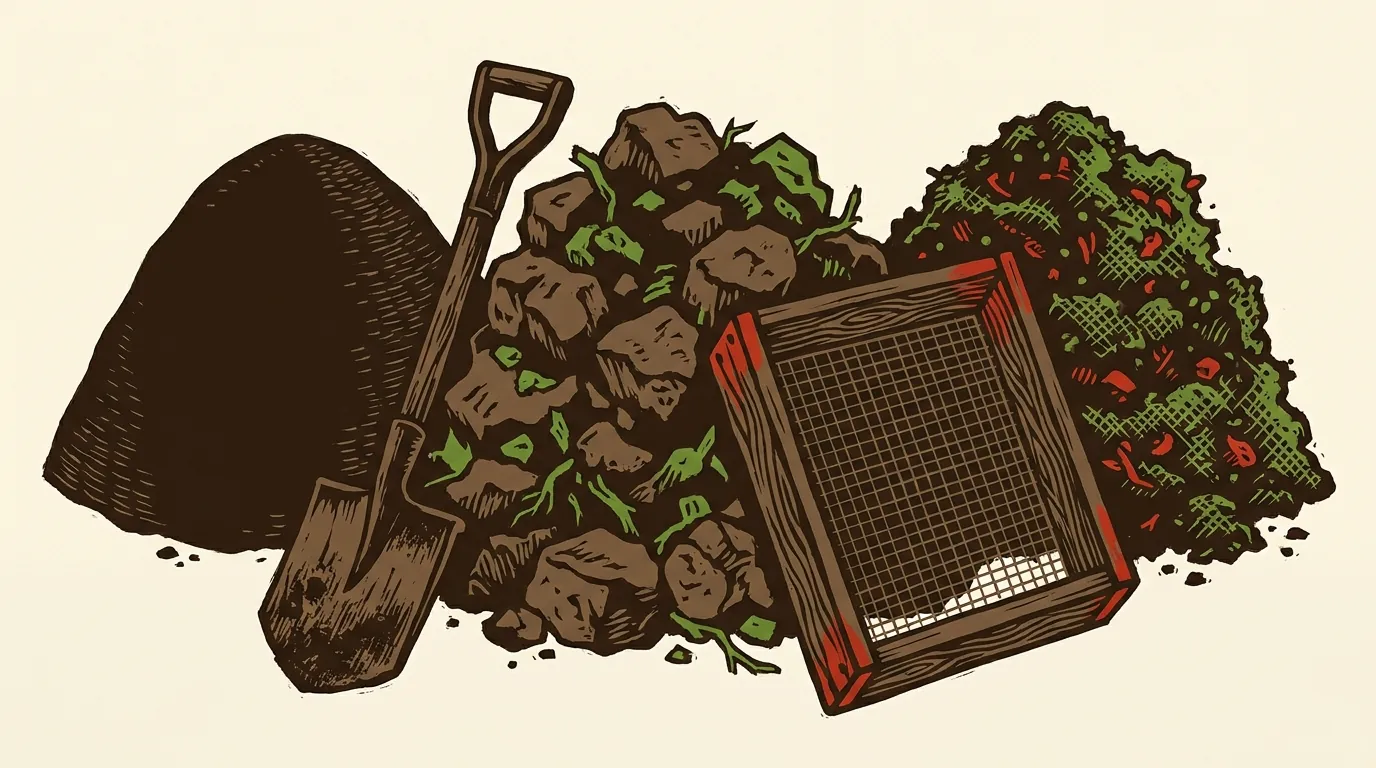
The main types of topsoil you can buy
| Type | What it is | Good for | Watch out for |
|---|---|---|---|
| Screened topsoil | Topsoil sieved through a mesh to remove stones, roots, clods and debris | Lawns, garden beds, raised bed blends, top dressing | Quality still varies; screening doesn’t remove weed seeds |
| Unscreened topsoil | Topsoil as it was dug, lumps and all | Rough grading, filling, the bottom of deep fills | Stones, roots and clods; hard to level |
| Blended or amended topsoil | Screened topsoil mixed with compost, sand or both; often sold as garden mix, lawn mix or planting mix | New beds, raised beds, new lawns | Ask for the ratio; very compost-heavy blends settle more |
| Bagged topsoil | Packaged topsoil, often lighter and higher in organic matter than bulk | Small jobs, patching, places a truck can’t reach | Read the label; contents vary widely between products |
Screened vs unscreened topsoil
Screened topsoil has gone through a screening machine, a vibrating or rotating mesh that lets fine soil through and rejects stones, roots and lumps. The result is loose, even and easy to rake smooth. Ask your supplier what screen size they use; a finer screen gives a smoother product.
Unscreened topsoil is cheaper and fine where looks and smoothness don’t matter, such as filling a low corner, building up a slope, or the bottom layer of a big fill. Most people put a few inches of screened topsoil on top before seeding or planting.
Screening only removes things bigger than the mesh. It doesn’t change the soil’s texture, its nutrients or its weed seeds.
Topsoil by texture
Soil scientists describe texture by the mix of sand, silt and clay. Suppliers often use the same words:
| Texture | Feels like | Behaviour |
|---|---|---|
| Sandy loam | Gritty, crumbles easily | Drains quickly, warms fast, needs watering and feeding more often |
| Loam | Smooth-gritty, holds shape loosely | A balance of drainage and moisture holding; what most gardeners want |
| Silt loam | Smooth, floury when dry | Holds moisture well; can crust on top |
| Clay loam | Sticky when wet, hard when dry | Holds water and nutrients; drains slowly and compacts if worked wet |
A quick jar test: half-fill a clear jar with soil, top it up with water and a pinch of dish soap, shake hard and leave it. Sand settles in a minute or two, silt over a few hours, and clay can take a day or more. The thickness of each layer gives a rough idea of the texture.
Regional names
- Black dirt. Used especially in the upper Midwest for dark, organic-rich topsoil. Some products sold under the name contain a lot of peat. They are dark and fluffy but can shrink and settle more than mineral topsoil.
- Loam. Often used loosely to mean any good-quality topsoil, not always a true loam texture.
- Garden soil or garden mix. Usually topsoil blended with compost. See topsoil vs garden soil.
Whatever the local name, ask the same questions: where did it come from, is it screened, what is it blended with, and is there a soil test?
How to judge a load of topsoil
- Look. Dark brown to black is typical of soil with organic matter, though colour varies by region. Watch for trash, construction debris, large stones and lots of roots.
- Squeeze. Slightly moist topsoil should crumble when you open your hand. Soil that forms a hard, shiny ribbon is very clay-heavy; soil that won’t hold together at all is very sandy.
- Smell. Good soil smells earthy. A sour or chemical smell is a warning sign.
- Weeds. A stockpile sprouting weeds will bring them home. Ask how long it has been stored.
- Test. Ask for a recent soil test, or test a sample yourself after delivery. pH and nutrient levels tell you what to add before you plant.
Which type for which job
- New lawn: screened topsoil, loam or sandy loam, 4–6 inches. See topsoil for a lawn.
- Vegetable and flower beds: screened topsoil blended with compost, or a garden mix. See the garden soil calculator.
- Raised beds: a topsoil and compost blend. See the raised bed soil mix calculator.
- Grading and filling: unscreened topsoil or fill underneath, screened topsoil on top.
Once you’ve chosen, work out the quantity with the topsoil calculator and compare prices with the topsoil cost guide.
Questions gardeners ask
- What is screened topsoil?
- Topsoil that has been passed through a mesh screen to remove stones, roots, clods and debris. It spreads and levels easily, which makes it the usual choice for lawns and garden beds.
- Is unscreened topsoil any good?
- It can be fine for rough grading, filling low areas or building up ground that will later get a screened layer on top. It is harder to spread smoothly and may contain stones, roots and weed pieces.
- What is black dirt?
- A regional name, common in the upper Midwest, for dark, organic-rich topsoil. What is sold under the name varies, and some of it is high in peat, so ask the supplier what is in it.
- How can I tell if topsoil is good quality?
- It should be dark, crumbly when slightly moist, smell earthy, and be mostly free of stones, trash, roots and sprouting weeds. A soil test tells you its pH and nutrients.